This guide is the spending order that works: which bike to buy first, which bikes to skip, and which upgrades to buy before the rest.
How Bike Prices Work
Every bike has two prices attached to it: a cash price and a level requirement. You cannot buy a bike until you reach its level, no matter how much cash you have.
The ladder starts free and climbs fast. The starter bike, the FZH Turbo, costs nothing. The first bikes after it are cheap — the V900-CX at $2,500, the KF 450T at $5,000, the CX 750F at $10,000. By the middle of the garage you are paying $60,000 for the NJ 350 and $100,000 for the ZX 750. At the top, the GST 1300 costs $325,000, the FX 10S costs $350,000, and the DCT 8910H costs $480,000 at Level 37.
One bike breaks the pattern: the SR 1000Z costs 300 Gold instead of cash. Gold is the game’s premium currency — you earn it slowly, so think hard before spending it on a single bike.
You earn the cash from missions and from near-miss bonuses: complete missions, stack near misses, and avoid crashing, and every payout is bigger. Replaying missions you already know is the fastest honest way to earn.
See the full ladder with every price and level in our complete bike list with prices.
Best First Bike
Two of our own pages answer this, and they agree more than they disagree.
Our bike list says the KF 450T at $5,000 is the first bike that feels like a real upgrade over the starter, and the Shadow R at $30,000 will carry you comfortably through the early career missions. That is the price-ladder answer: spend $5,000, feel the difference, save for $30,000, and you are set for the early game.
Our speed ranking says something similar from the other side: a balanced, affordable option like the MX-450S, with enough speed and control to clear early missions comfortably while you save for the superbikes. That is the speed answer, and it points at the same idea — buy balance first, not the fastest thing you can barely afford.
Put them together and the rule is simple: your first real bike should be a balanced upgrade you can afford without emptying your savings. The KF 450T fits that rule on price. The MX-450S fits it on balance. Either way, do not spend everything you have on one bike — you still need cash for upgrades.
For the full speed ranking, see our top 10 best bikes in Traffic Rider.
Upgrade Order: Engine vs Tyres vs Handling
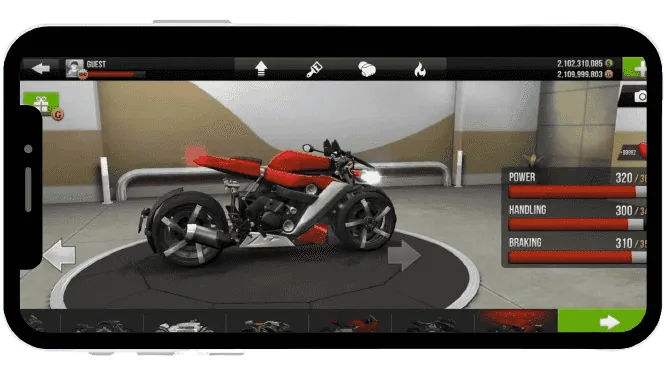
Once you own a bike, the garage offers three upgrade lines: engine, tyres, and handling. The order you buy them in matters, because the first upgrade pays for the rest.
Engine first. Top speed and acceleration decide how fast you finish missions and how many near misses you can stack in a run. More speed means more cash per ride, and more cash means the next upgrade comes sooner. Engine is the only upgrade that directly increases what you earn.
Tyres second. Grip is what lets you ride close to traffic without crashing — and near misses are where the bonus cash lives. Better tyres mean tighter overtakes, fewer crashes, and bigger payouts per run. Tyres pay for themselves through the bonuses they unlock.
Handling third. Steering matters most at high speed and in dense traffic, which is exactly where the fastest bikes live. On a slow early bike you will barely feel it. On a superbike you will feel it every second. Buy handling when the bike is fast enough to need it.
The same order works on every bike: engine, then tyres, then handling. Max out one bike before you start upgrading the next — a half-upgraded garage is slower than one fully upgraded bike.
Bikes Not Worth Buying Early
The biggest cash waste in Traffic Rider is buying every bike in order. Most bikes get replaced quickly, and every small step up the ladder is cash you will never get back.
Skip the small steps. Going from the V900-CX at $2,500 to the KF 450T at $5,000 is a real jump. Going from the $20,000 KBX 250 to the $30,000 Shadow R is also a real jump. But buying every bike between them, one after another, is not progress — it is shopping. Save for the next big jump instead of buying the next bike on the list.
Do not spend Gold early. The SR 1000Z costs 300 Gold, and Gold is the one currency you cannot grind back quickly. Spend it on a bike before you know whether that bike suits you, and you have traded months of slow earning for one machine. Buy cash bikes first, and let Gold wait until you know exactly what you want it for.
Do not buy a superbike before you can ride it. A $350,000 FX 10S in the hands of a player who still crashes in light traffic earns less than a $30,000 Shadow R ridden clean. Speed only pays when you survive the run. If you are still crashing, spend the cash on upgrades for the bike you have, not on a faster bike you cannot control yet.
FAQ About Traffic Rider Bike Upgrades
Should I buy the most expensive bike I can afford?
No. Buy the next big jump, not the next bike on the list. A bike that costs everything you have leaves nothing for upgrades — and an unupgraded expensive bike is slower than a fully upgraded cheaper one.
Do bikes change gameplay or just looks?
They genuinely change how the game feels. Top speed, acceleration, and handling are different on every bike, and the difference shows in your mission times and your near-miss bonuses.
What is the fastest bike in Traffic Rider?
The LAZ-400, at 407 km/h. It leads our speed ranking — but it is an end-game machine, not a first purchase. Earn your way to it through the order above.
Conclusion: Traffic Rider Bike Upgrades
Spend in jumps, not in steps. First real bike: the KF 450T. Early career: the Shadow R. Upgrades in order: engine, tyres, handling. Gold stays in your pocket until you know exactly what it is for. That is the whole guide — and it is the difference between a garage full of bikes you never ride and one bike that carries you to the top.